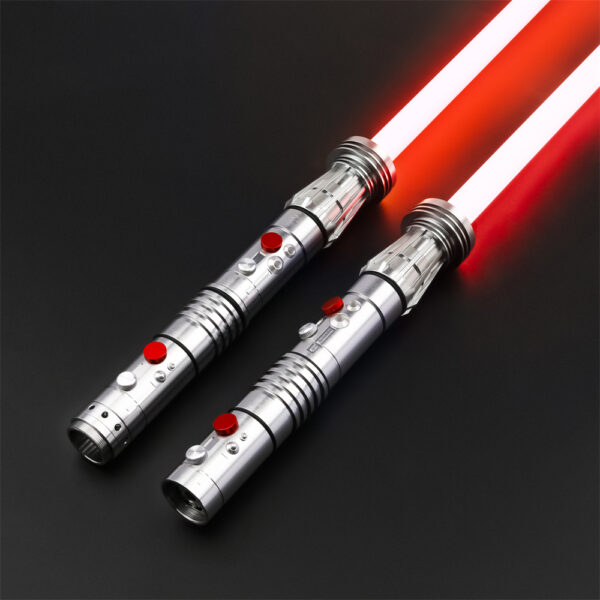
The workshop was quiet in the way only late workshops are quiet — the hush after every tool has been put down, when the ember at the heart of the forge has cooled to the colour of a first sunrise and the smith has stopped moving because there is nothing left to do. A single low lamp burned above the bench. The rest of the room fell away into carbon shadow. On the felt-lined tray, angled just so, lay the blade — hilt cold, emitter dark, weight distributed the way he had spent forty long evenings distributing it. He looked at it. It looked back, in the mute way that objects do when they have taken on a life you did not intend to give them.
He had not switched it on. He would not, not yet. To ignite the blade was to invite a decision, and the smith had learned — over years, over hundreds of hilts sent away in paper and packing — that decisions of this kind should never be rushed. Better to sit with a thing. Better to let the quiet ask its own questions. The felt gathered warmth from the metal, or from the room, or from him. It was hard to say. Outside, the wind pressed against the shutters and moved on. Inside, only the low lamp, only the blade, only the smith who had never kept one.
The Ones He Sent Away
He had built sabers for others for years — a truth so plain he no longer counted the count. There had been the first one, of course, and the first is always remembered; a nervous, over-tightened piece with a soundboard he had wired three times before he trusted it. Its owner had paid in cash and left with a joy the smith recognised only in retrospect. There had been the wedding hilt — brushed titanium, initials engraved along the pommel — commissioned by a bride who wanted her groom to duel her at the reception. The heavy-duelling grade for a duelist in Adelaide who had asked for a blade the colour of rust, because rust reminded him of his father's shed. The small quiet one, ordered by a father for a son, blade retracted always to the child's height. The single-emitter economy piece paid off in fortnightly instalments by a nurse who had wanted, for reasons she did not share, a saber the colour of grief.
He remembered them the way a mason remembers walls: not by their finished faces, but by the moments where a hand had slipped, or a decision had been made against an easy choice. He knew the interior of every hilt he had built. He knew the little compromise where a pommel plate had been sanded thinner than specification because a customer had asked for a lighter piece. He knew the crystal chamber where he had wound the copper an extra half-turn for a duelist who wanted her blade to hum a lower note.
All of them had been sent away. Not one of them had stayed on the bench. Not one had been switched on and considered and kept. The smith had never quite understood why. It was not exactly discipline. It was closer to something he had once heard a violin-maker say, in an interview years ago — that the maker who plays too often becomes the maker who no longer makes. The instrument, at some point, is either sold or it is not. Between the two states there is no third.
The Blade That Would Not Leave
This one was different. He had known it from the crystal.
The crystal had come to him without ceremony — a plain grey stone in a plain grey bag, indistinguishable to any test he could put a stone through, and yet it had sat in his palm on the first day and refused to say what colour it wanted to be. Every crystal, in his experience, wanted something. He had held green ones that all but chose their emitters. He had held blue crystals that hummed against the copper as he wound it. He had held the amber ones — the difficult ones — that pushed back against a duelist's grip until you loosened your hand and let them decide the balance. But this one had lain silent. It had waited.
You do not choose the blade. The blade chooses the hand that carries it.
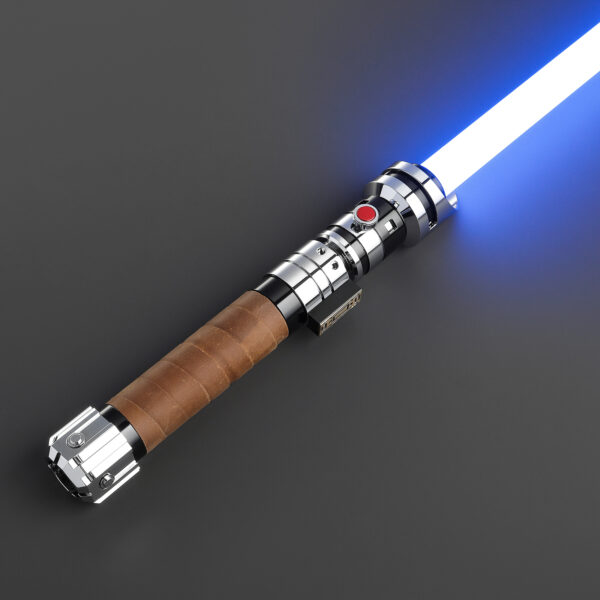
He had set it aside for a fortnight, thinking the silence would pass. It did not. He had begun the hilt anyway, because a smith does not sit forever with a stone; a smith works, and the work asks the questions the stone will not. He had milled the pommel long and tapering. He had cut the emitter shroud in matte carbon, ridged for grip. He had polished the choke to a soft graphite sheen that caught the low workshop light and held it. Every choice had been made by his hand, and yet every choice had been made — he could not shake the sense — by the blade in advance of the hand. He had been the instrument, and the blade had been the maker. He had never felt that before.
Now it lay on the tray, complete. It was not, by any measurable metric, the finest hilt he had ever built. It was slightly heavier than his usual specification. The choke was a fraction longer than he would have machined it if he had been thinking with only his own head. And yet the smith knew — as one knows things one cannot prove — that of every hilt he had sent away, this was the first one that had never intended to leave. It had chosen the workshop. Or, more particularly, it had chosen the hand that had wound its copper and set its crystal and closed its pommel. The blade, in the plain silence of the late workshop, was waiting for him to admit it.
The Weight of a Hand Upon the Hilt
He had spent an hour, perhaps two, sitting with the question. The lamp did not care. The felt did not care. The blade rested exactly where he had laid it, and the emitter angled away from him with the polite indifference of an object that has already decided and is waiting for the human in the room to catch up.
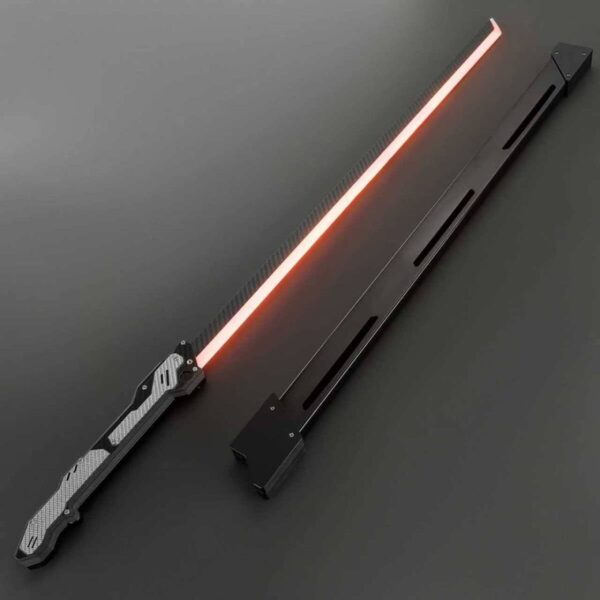
Elsewhere in the workshop, other hilts lay unfinished — the Carbon Strike he had not yet named, unengraved, its shroud still bare; the Starkiller he had begun in the spring for a duelist in Vancouver, whose deposit had cleared last week. They would be finished. They would be sent. The smith had no illusions about the trade. Sabers are not made by smiths who keep them; sabers are made by smiths who send them, and the difference is not romance, it is simply arithmetic. A workshop that keeps its work has, sooner rather than later, no work to keep.
And yet.
He reached, at last, for the hilt. His fingers found the choke without looking — the ridged carbon warmed already from the room, or from itself, and the pommel settled naturally against the fleshy heel of his palm. He had done this a thousand times. He had held every hilt he had ever built, briefly, in the final check before it went into its case. A saber cannot be shipped by a smith who has not held it. That was old lore in every workshop he had known.
But this holding was different. This holding was not the final check before a saber went into its case. This holding was — he understood now, in the way a person understands a thing they have refused for a long time to understand — a claiming. The smith closed his eyes. The workshop was very quiet. The blade, undignified, warm, patient, waited in his hand for the question the smith had spent a career refusing to ask himself.
Did he want to keep it?
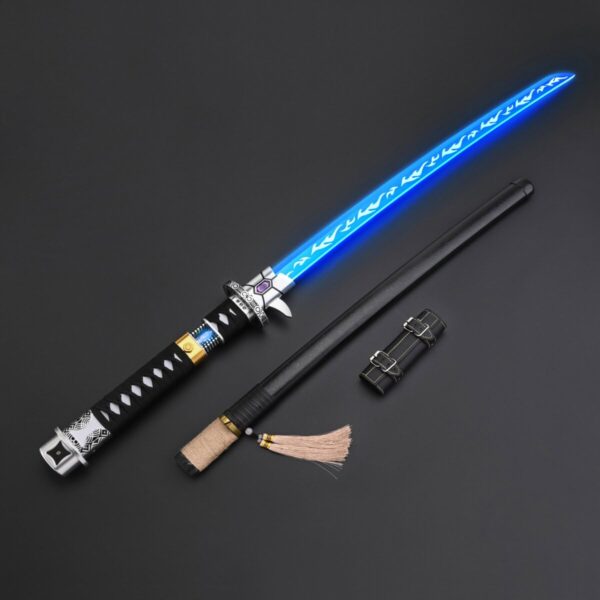
The Myth You Do Not Wear — You Become
The story we tell ourselves about sabers, in the trade and outside it, is a story about ownership. The saber belongs to the Jedi. The saber belongs to the duelist. The saber is a possession, a piece of kit, a purchase, a delivery — from factory floor to your door, as the brand up the coast liked to say. And so it is. There is nothing dishonest in the transaction. Ten thousand hilts a year cross ten thousand doorsteps and are held by ten thousand hands that did not build them, and every one of those is a saber given a life.
But there is another story, older and quieter, and it is the story the smith had refused to speak aloud for the whole of his career. The saber is not, in the older story, a possession. The saber is a decision the wielder makes about the person the wielder intends to become. To take up a blade is to take up the myth that goes with the blade — the mask you wear, the code you inherit, the shape you begin to make with your body when your body knows there is a weight in its hand. The Jedi did not carry sabers because sabers were tools; the Jedi carried sabers because carrying was the act of becoming. The mask is not worn. The mask is grown into.
The smith, in the low light, was thinking of masks. He was thinking of the boy he had been at seventeen, in a rented flat with a cheap toy saber from a market stall and a poster of an old Jedi Master on the wall. He was thinking of the man he had been at twenty-eight, when he had built his first proper hilt from milled parts and machined tolerances and had known, with the clarity of first work, that a saber was a lesser thing when kept and a greater thing when given. He had believed that then. He had built a whole life on it. He was no longer, tonight, certain it was true.
The Kyber sings to those who listen.
Ancient Jedi Codex, unnumbered fragment
The blade lay in his hand. The felt was very warm. He thought, for a long time, that he would not switch it on — that he would set it back on the tray and close the workshop and send it, in the morning, to no one at all. He would keep it dark. He would keep it silent. He would keep it, because keeping a dark saber was not the same as keeping a lit one; keeping a lit one was a claim, and claims were what the smith had spent forty years refusing to make.
Then he thumbed the switch.
The blade came on with the small warm cough all blades come on with, and the workshop filled with a light the colour of the crystal's mind — not blue, not green, not the red of a duelist who had chosen his path; a colour older and quieter, the colour of a first sunrise seen from a workshop shutter that has not been opened for years. The smith held the blade steady. He watched the light lie against the carbon of the wall and the graphite of the choke and the small dust of the felt. He did not move for a long time. When he did move, he moved the blade, once, slowly, in the arc of the guard he had first learned to draw at seventeen. His shoulders remembered. His hands remembered. The blade remembered.
He had taken up the myth. He would learn to wear the mask. He would live, from tonight, the story he had built for other people to live.
He set the blade down, still lit. He watched the workshop breathe.
— Chloe