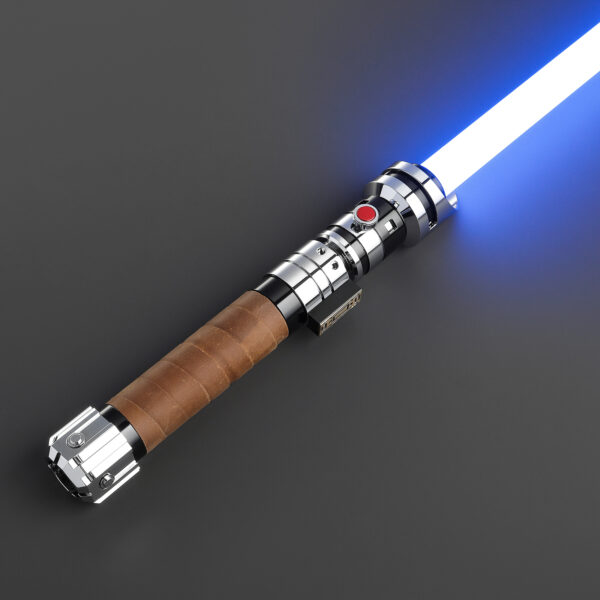
There's a moment, when a saber first ignites in a quiet room, that every collector remembers. The hum settles, the blade catches the light, and for about three seconds you are standing somewhere the walls of your house cannot see. It's a good moment. It is also, if you've bought only the saber, the whole moment. That's not a criticism — plenty of collectors want exactly that and nothing else. But there is a second act to this fantasy, and it doesn't cost as much as most people assume. It just asks you to think about what you are actually collecting, and who you are when you turn the lights out and switch the blade on.
This guide is for the collector staring at a helmet in the shop tab and wondering whether it's worth the second purchase. The short answer is yes, and not for the reason you're expecting. Read on for the long one.
The blade alone
A saber on its own is a beautiful object. There is nothing wrong with owning one and only one, ever. In display terms it holds its own — a hilt on a stand is one of the more atmospheric pieces of home decor a fan can commit to, and a lit blade in a dim room reads as sculpture more than merchandise. If you like the idea of guests walking past your shelf and stopping short, the blade alone is doing all the work you need it to.
It also carries the moment of ignition, which is genuinely the thing most of us bought a saber for. The rising hum, the punch of the leading edge climbing to full extension, the little click as the sound font lands on its idle loop — that's the experience being sold, and a well-built saber delivers it every time you press the button. On our Xenopixel V3 and Proffie 2.2 Cores you get that sequence with real production-grade audio, and with our RGB-X and S-RGB baselit Cores you get it at an entry price most competitors reserve for a mid-tier build.
What the blade cannot do is put you inside the scene. When you're the one holding it, you are still visibly you — in your jumper, in your kitchen, in your everyday face. The blade is doing all the work of being cinematic, and the person holding it is doing all the work of being ordinary. For a lot of collectors that gap doesn't matter, and it isn't meant to. But for anyone who has ever thought about wearing the saber somewhere — a convention, a photo shoot, a Halloween party, an at-home costume moment with the right lens flare — that gap is exactly the problem the helmet solves. It is the difference between owning the thing and being the person who owns the thing.
The helmet alone
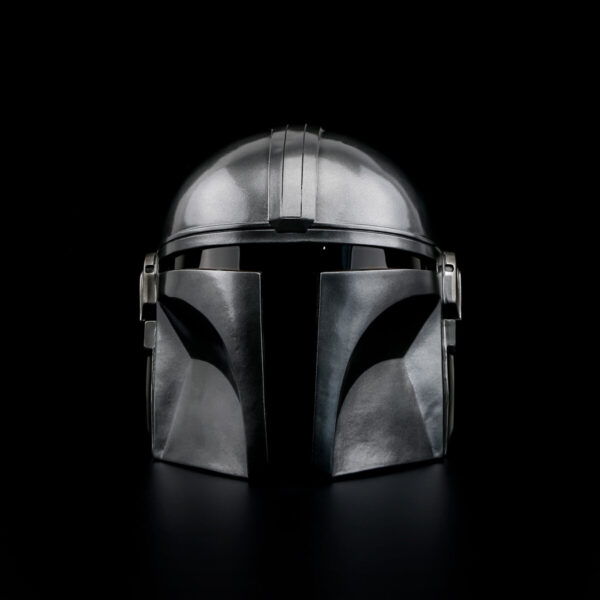
Now flip it. A helmet on its own is a very different object. It reads less as a prop and more as a piece of costume, which means it does something a saber never quite can — it hides the wearer's face. Silhouette becomes character. A Mandalorian helmet on your head, in the dim of a party or in front of a phone camera, is instantly and unmistakably a Mandalorian. No context, no explanation, no polite squinting from the person you're talking to. The signal is total.
That's the thing helmets do that sabers don't. They character-lock. They give the person underneath a public identity that the saber, however photogenic on the shelf, doesn't quite finish. Even a plain hilt is still "a lightsaber" first and "a Kylo Ren build" second. A Kylo Ren mask is Kylo Ren from twenty feet away.
The trade, though, runs the other way. A helmet on its own has nowhere to point. It is potential energy without a story to spend it on. You put it on, you look in the mirror, and there is a moment of recognition — and then the hands are empty and the scene fizzles. Costume without the prop is a bit like the ignition sequence without the blade. You get the setup and none of the release.
A helmet turns a saber from a solo prop into a costume. Costume-ready shifts your collection from displayable to wearable.
Why the pair works
Put them together and something changes that neither piece can do on its own. You stop being a person holding a prop and start being a character inhabiting a scene. The technical term for this in cosplay circles is lock-in, and it's more than a fandom in-joke — there's a real reason a full costume feels different from a partial one. When your face is hidden and your hands are occupied, your posture changes without you thinking about it. You stand differently. You walk differently. The moment lasts longer than three seconds, because now the moment has somewhere to go.
Practically, this is what shifts your collection from displayable to wearable. A hilt on a stand asks to be looked at. A hilt in the hand of someone in a helmet asks to be photographed, to be filmed, to be worn to the friend's Halloween party, to be the reason you finally book the studio hour you've been thinking about all year. It becomes an experience you can use, not just an object you can point at.
There is also a quieter reason the pair works, and it's more about you than it is about the collection. Owning both feels like completing a thought. The saber is the promise; the helmet is the follow-through. Most collectors we hear from — and we hear from a lot of collectors, that's kind of the point of this shop — describe the same arc: they buy the blade, live with it for a season, and then find themselves on the helmet page one evening with a strong sense that something is unfinished. Nothing on the site made them feel that. The saber did. The pair works because it closes a loop the single object opened, and once you've heard that click it's very hard to unhear.
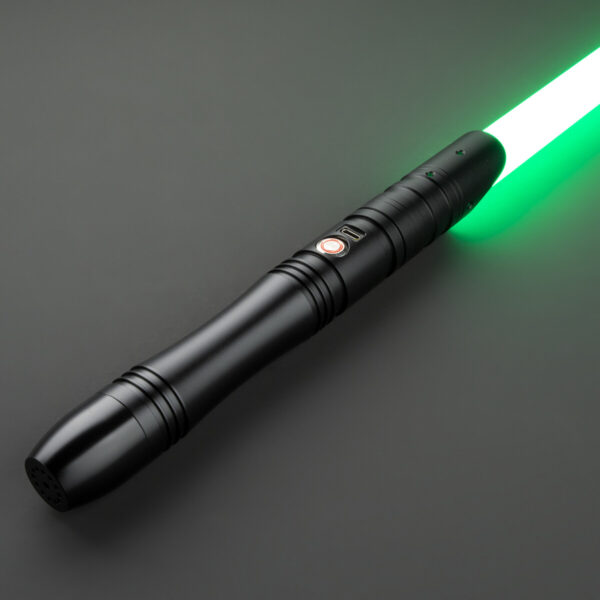
Three pairings we love
Not every saber wants a helmet next to it, and not every helmet fits with every hilt. Some pairs are so canonically joined that owning one without the other feels like it's missing a chapter. Here are three we recommend without hesitation, each drawn straight from our catalogue.
-
Darth Vader EP6 ROTJ · Vader Helmet
The classic. The Return of the Jedi hilt has that hand-tooled weight to it — the pommel, the ribbed neck, the copper accents — and it earns every inch of screen presence when the mask is on the shoulders holding it. This is the pairing that turns a collector shelf into a scene. Costume-ready end to end.
-
Kylo Ren Signature · Kylo Ren Mask
The crossguard alone is one of the most photogenic saber silhouettes we sell — those two little side blades sparking off the main are a signature move on any Core tier. Add the fractured mask and you've got the most modern Sith energy in the catalogue: unstable, unfinished, dramatic. Two objects that are stronger together than either is apart.
-
The Mandalorian Darksaber · Mandalorian Helmet
The T-visor is one of the most instantly readable silhouettes in modern Star Wars, and the Darksaber's flat, black-cored blade is the only saber in the range that visibly matches its wearer. If you want a pair that photographs well, that reads at any distance, and that carries a whole ongoing story with it — this is the one to buy together, not in stages.
Whichever pair you choose, treat the helmet as the second act rather than the second purchase. The first hilt is a great single object; the pair is the moment the collection starts telling a story about you, not just about Star Wars. And if you're worried about the second buy feeling like a duplicate — it doesn't. Every collector we've spoken to says the same thing: the helmet doesn't make the saber less special, it makes it more so. The pair is why you got into this in the first place.
May the force be with you both.